How Will LED Signs Be a Sustainable Option? The Future of Energy-Efficient Business Signage
When most NYC business owners think about sustainability they think about recycling programs, energy-efficient appliances, or switching to renewable electricity. Very few think about their signage. Yet the sign hanging above your storefront or illuminating your window display runs every single day, often 12 to 16 hours, consuming electricity and generating heat continuously.
In a city like New York where energy costs are among the highest in the entire United States and where environmental regulations are tightening every year, the type of signage you choose is no longer just an aesthetic decision. It is a financial and environmental one.
LED signs have emerged as the clear sustainable choice for modern businesses. But beyond the marketing buzzwords what does the data actually say? How much energy do LED signs really save? What is their environmental impact? And does the upfront investment actually make financial sense for a small NYC business?
This post breaks it all down with real numbers.
The Energy Crisis Hidden in Traditional Signage
Before understanding why LEDs are sustainable you need to understand what they replace.
Traditional neon signs and fluorescent illuminated signs were the standard for decades across NYC storefronts, restaurants, hotels, and retail businesses. They looked iconic and they worked. But their energy consumption was significant and their environmental footprint was considerable.
A standard neon sign typically consumes between 3 to 5 watts per foot of tubing. A medium sized neon storefront sign running 12 hours daily consumes roughly 1,500 to 2,000 kilowatt hours annually. At New York City's average commercial electricity rate of approximately $0.17 per kilowatt hour that translates to $255 to $340 per year in electricity costs for a single sign.
Multiply that across hundreds of thousands of NYC businesses and the cumulative energy consumption becomes staggering.
Fluorescent signs present additional problems beyond energy consumption. They contain mercury vapor, a toxic heavy metal that requires specialized disposal. The EPA classifies mercury-containing fluorescent lamps as hazardous waste meaning improper disposal carries both environmental consequences and potential legal liability for business owners.
What LED Technology Actually Does Differently?

LED stands for Light Emitting Diode. Unlike neon or fluorescent technology which generates light by exciting gases or heating filaments, LEDs produce light through electroluminescence, a process where electricity directly stimulates electrons to release photons. This process generates dramatically less heat and wastes far less energy.
The U.S. Department of Energy has documented that LED lighting uses at least 75% less energy than traditional incandescent lighting and lasts 25 times longer. While this figure applies broadly to LED lighting the efficiency gains are equally significant in commercial signage applications.
For signage specifically the International Sign Association reports that LED sign modules consume approximately 0.1 to 0.3 watts per module compared to significantly higher consumption rates for neon and fluorescent alternatives. A full LED illuminated channel letter sign for a typical NYC storefront running 12 hours daily can consume as little as 300 to 500 kilowatt hours annually, a reduction of up to 75% compared to equivalent neon signage.
At NYC commercial electricity rates that translates to roughly $51 to $85 per year in electricity costs versus $255 to $340 for neon. The annual saving on electricity alone ranges from $170 to $255 per sign.
The Real Numbers: LED vs Neon vs Fluorescent Comparison
Let's put the data side by side for a medium sized NYC storefront sign running 12 hours daily for 365 days:
Neon Sign — Annual energy consumption approximately 1,800 kWh | Annual electricity cost at NYC rates approximately $306 | Average lifespan 8 to 15 years | Contains hazardous materials: yes (argon and mercury gases) | Maintenance frequency: high, glass tubes break easily.
Fluorescent Illuminated Sign — Annual energy consumption approximately 1,400 kWh | Annual electricity cost at NYC rates approximately $238 | Average lifespan 7 to 10 years | Contains hazardous materials: yes (mercury vapor lamps) | Maintenance frequency: moderate to high.
LED Sign — Annual energy consumption approximately 400 kWh | Annual electricity cost at NYC rates approximately $68 | Average lifespan 50,000 to 100,000 hours of operation | Contains hazardous materials: no | Maintenance frequency: very low.
Over a 10 year period a business switching from neon sign to LED saves approximately $2,380 in electricity costs from a single sign. That figure does not include maintenance savings, replacement costs, or the avoided expense of hazardous material disposal.
Carbon Footprint Reduction: The Environmental Case
Energy savings directly translate to carbon emission reductions. The EPA's Greenhouse Gas Equivalencies Calculator provides a clear framework for understanding this impact.
New York State's electricity grid produces approximately 0.00317 metric tons of CO2 per kilowatt hour consumed. Using our earlier figures a single business switching from neon to LED signage reduces annual energy consumption by approximately 1,400 kWh. This translates to a reduction of roughly 0.44 metric tons of CO2 annually per sign.
That is the equivalent of taking a car off the road for approximately 47 days per year from a single sign change at a single business.
Now consider that New York City has over 230,000 small businesses according to NYC Small Business Services data. If even 10% of those businesses switched their primary exterior sign from neon or fluorescent to LED the cumulative annual CO2 reduction would exceed 10,000 metric tons — equivalent to removing over 2,000 cars from NYC roads permanently.
LED Signs and NYC's Local Law 97
This is critically important for NYC business owners specifically and most signage guides completely miss this point.
New York City's Local Law 97, part of the Climate Mobilization Act, sets aggressive carbon emission limits for buildings over 25,000 square feet with significant financial penalties for non-compliance. While most small storefronts fall below this threshold the law represents a clear regulatory direction that NYC is moving toward stricter energy consumption standards across all building types over time.
Additionally NYC's Retrofit Accelerator program through the Mayor's Office of Sustainability actively encourages businesses to reduce energy consumption across all systems including lighting and signage. Businesses that proactively reduce their energy footprint position themselves ahead of future regulatory requirements rather than scrambling to catch up when compliance deadlines arrive.
Choosing LED signage today is not just an environmental decision it is a strategic business decision that aligns with where NYC's regulatory environment is clearly heading.
The Lifespan Advantage: Why LED Wins on Sustainability?
Sustainability is not only about energy consumption. It is also about resource consumption and how often products need to be manufactured, shipped, and disposed of.
LED signs have an operational lifespan of 50,000 to 100,000 hours. Running a sign 12 hours daily that translates to 11 to 22 years of operation before replacement is needed. Neon signs by comparison typically require full replacement or significant component replacement every 8 to 15 years, and individual neon tubes can fail much sooner particularly in NYC's harsh winter conditions.
The manufacturing and shipping of replacement signs consumes additional energy and raw materials. Every year of extended LED lifespan is a year where no new sign needs to be manufactured, packaged, and transported. When calculated across the full product lifecycle LED signs have a substantially lower environmental impact than any alternative technology.
Recyclability and End of Life Considerations
LED signs contain no mercury, no hazardous gases, and no toxic heavy metals in their light-producing components. This makes end-of-life disposal significantly simpler and less environmentally damaging than fluorescent alternatives.
The primary materials in LED signage — aluminum housings, acrylic faces, copper wiring, and LED modules — are all recyclable through standard commercial recycling channels. Many LED sign manufacturers now offer take-back programs for end-of-life components, further reducing landfill impact.
Compare this to neon signs which contain argon gas, mercury, and leaded glass that require specialized hazardous waste disposal facilities. In NYC improper disposal of mercury-containing lighting is subject to fines under the NYC Department of Sanitation regulations making proper disposal an additional cost and administrative burden for business owners.
The Financial Sustainability Argument
Sustainability is not only environmental, it is also financial. A business that cannot sustain its operating costs is not truly sustainable regardless of its environmental practices.
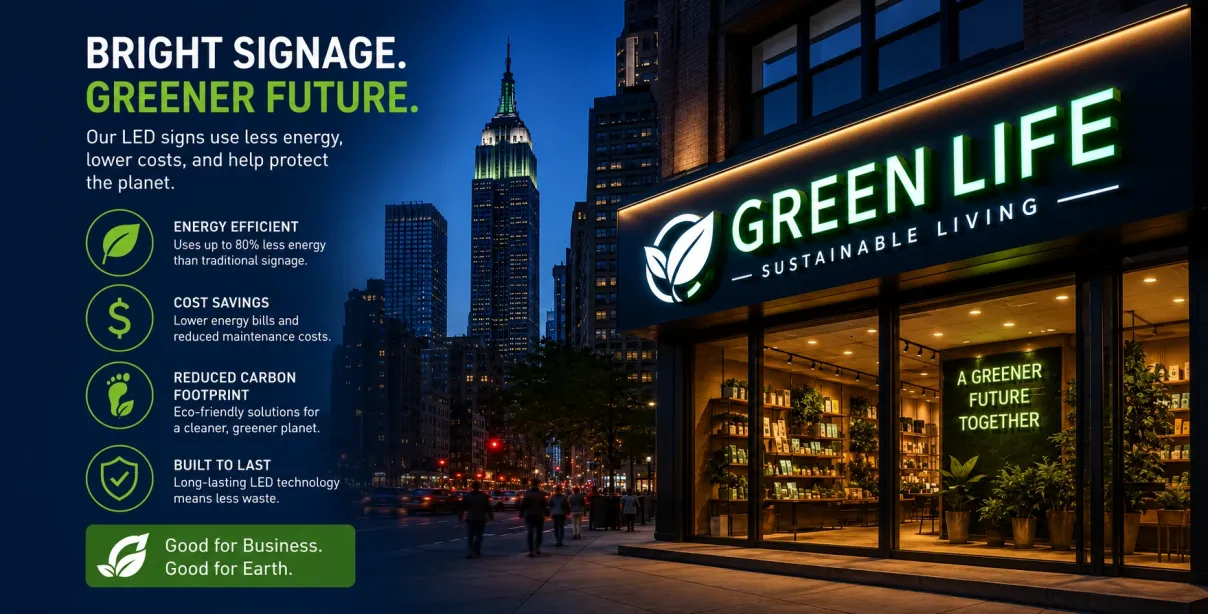
LED signs make financial sense on every metric. Lower electricity bills from day one, dramatically reduced maintenance costs over the sign's lifespan, longer replacement cycles meaning capital expenditure is deferred for over a decade, and no hazardous disposal costs at end of life.
For a typical NYC small business the total cost of ownership of an LED sign over 10 years is 40 to 60% lower than an equivalent neon or fluorescent sign when all factors are included. This financial sustainability directly supports business longevity and sustainable businesses are the foundation of sustainable communities.
Real NYC Business Impact
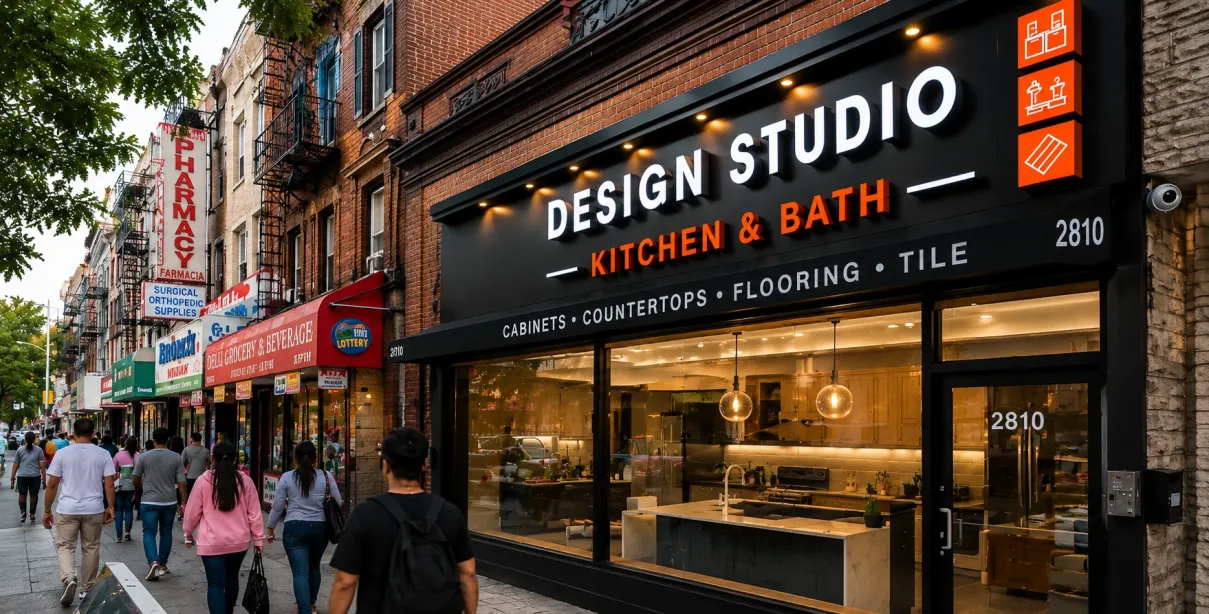
At NYCITY SIGNS we have worked with hundreds of NYC businesses across all five boroughs transitioning from traditional signage to LED solutions. The consistent feedback from business owners after switching is:
Lower monthly electricity bills, noticeable within the first billing cycle. Virtually zero maintenance calls compared to frequent neon tube replacements previously. Brighter and more consistent illumination that improves storefront visibility particularly in NYC's competitive retail corridors. And the ability to dim or program LED signs to reduce consumption further during off-peak hours.
These are not theoretical benefits. They are the practical daily reality of LED signage for NYC businesses.
Conclusion: LED Signs Are Not Just a Trend, They Are the Standard
The evidence is clear and the data is overwhelming. LED signs consume up to 75% less energy than traditional alternatives, last 2 to 3 times longer, contain no hazardous materials, produce significantly lower carbon emissions, and deliver substantially lower total ownership costs over their operational life.
For NYC business owners operating in one of the most energy-expensive cities in America, in a regulatory environment that is progressively tightening energy standards, and in a marketplace where consumers increasingly notice and reward environmentally conscious businesses, the choice of LED signage is not just the sustainable option. It is the smart business option.
The question is no longer whether LED signs are worth the investment. The question is how much longer you can afford to keep paying for the alternative.
Read Our More Blogs
How Can Signs Make Your Customer Repeatable? The Psychology Behind Signage and Brand Recall
Discover how strategic business signage improves brand recall, customer retention, and repeat visits using proven psychology and real data.
Why Are Fire Safety Signs Essential For Business to Protect Employees Every Day Always?
Learn why fire safety signs are essential for businesses, helping improve workplace safety, legal compliance, emergency awareness, and protection.
How to Choose the Perfect Color for Your Sign to Attract Customers? A Real Guide From the Streets of NYC
Color is never just color. A real, street-tested guide on how NYC business owners can choose sign colors that stop foot traffic, communicate the right emotion, and outperform competitors on even the busiest blocks.